

Authored by CM Law Partner Mike Piazza, this client alert examines the urgent steps importers must take to protect IEEPA tariff refund rights—through CAPE submissions, CBP protests, and CIT litigation—following the Supreme Court’s invalidation of IEEPA-based duties, while also previewing a converging wave of new tariff actions in July 2026, including proposed Section 301 forced-labor and excess-capacity tariffs, the expiration of the Section 122 global tariff, and expanding Section 232 investigations.
Executive Summary: What to Do This Week
- Protect refund rights now: identify IEEPA entries that are final, nearing finality, or still within the 180-day protest window.
- Use CAPE where available: submit eligible entries and confirm CBP has current ACH refund information.
- Do not miss protest deadlines: file CBP Form 19 protests for liquidated entries before the 180-day window closes.
- Consider litigation for high-value final entries: a CIT case may be needed where CBP says it cannot refund without a court order.
Why This Matters Now
Importers face two urgent issues. First, the Supreme Court has held that IEEPA does not authorize tariffs, putting roughly $166 billion in duties at issue. But the government is now trying to limit refunds to importers that preserved their own claims. Companies that wait for a universal refund, or rely only on CBP’s process, may lose recovery rights once entries become final. Second, a new tariff wave is building for July 2026. Forced-labor tariffs, excess-capacity investigations, the expiration of the 10% global tariff, and Section 232 actions are all moving at once. Importers should act now. The key deadlines are weeks away.
The IEEPA Refund Battle: Universal Relief Under Attack
Learning Resources remains the law: IEEPA duties were unlawfully collected. The dispute now is not whether refunds are owed, but who gets them and how quickly. Interest is adding roughly $650 million per month.
On June 2, 2026, the government appealed the Court of International Trade’s universal refund orders and asked the Federal Circuit to block related CIT proceedings. Its core argument is simple: refunds should not automatically go to importers that were not parties to the case. If that argument succeeds, non-party importers could face long delays — or no universal refund at all.
For importers, the key question is where each entry stands:
-
- Unliquidated or nonfinal entries (~$85 billion). CBP acknowledges authority to refund these administratively through its CAPE system.
- Finally liquidated entries where the importer has filed a CIT case. The government accepts that court-ordered relief can compel reliquidation.
Finally liquidated entries with no CIT case filed. This is the danger zone. CBP says it cannot refund these entries without a court order. For many importers, an individual CIT action may be the only practical path to recovery.
A Three-Track Recovery Strategy: CAPE, Protests, and CIT Litigation
Track One — CAPE for Administratively Recoverable Entries
Use CAPE for entries CBP can still process administratively: generally, unliquidated entries or entries no more than 80 days past liquidation. Submit eligible entries and confirm refund payment information is current.
Track Two — CBP Protests to Preserve Administrative Rights
For liquidated entries still within 180 days, file a CBP Form 19 protest. This keeps the refund claim alive and preserves the option for CIT review if CBP denies relief.
Track Three — An Individual CIT Action
For finally liquidated entries, a CIT action may be needed to unlock any refund. The bottom line: filing may require patience, but waiting may forfeit the claim.
The Next Wave: Newly Proposed and Potentially Impending Tariffs
At the same time, the administration is building replacement tariff tools. Four July developments require immediate attention.
Proposed Section 301 Forced-Labor Tariffs (Comments Due July 6)
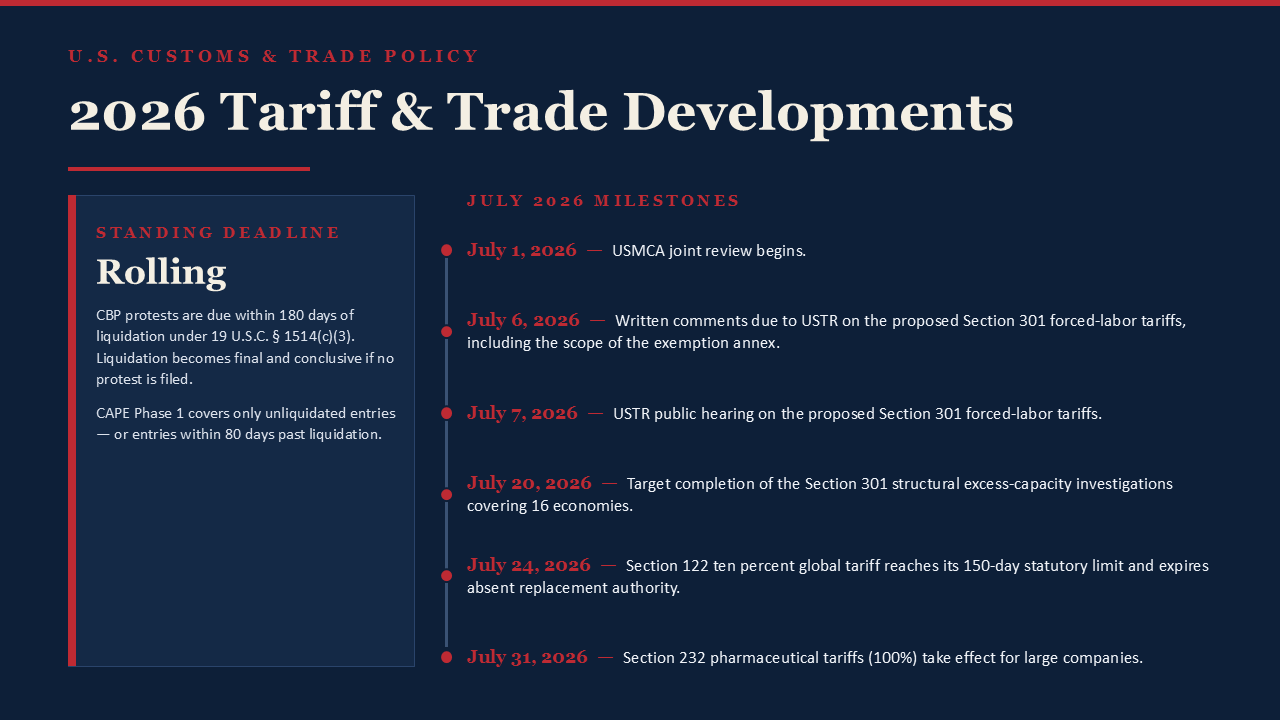
USTR has proposed new Section 301 tariffs on imports from 60 economies, including the EU, based on alleged forced-labor enforcement gaps. Proposed rates are 10% or 12.5%, depending on the country. Comments are due July 6, and a hearing is scheduled for July 7. Companies should check whether their products fall within the proposed exemptions — including aircraft parts, energy products, rare earths, certain metals, beef, coffee, pharmaceuticals, and goods already subject to Section 232 — and file comments to protect or expand those exemptions.
Pending Section 301 Excess-Capacity Investigations (16 Economies)
USTR is also investigating alleged excess capacity in 16 economies, including the EU, China, Japan, Korea, Mexico, India, Vietnam, and Taiwan. The sectors are broad: steel, aluminum, autos, transportation equipment, semiconductors, machinery, chemicals, and more. Rates and product scope are not yet known, but USTR appears to be moving toward late July action. This could become the broadest new tariff measure.
Section 122 Expiration and the Replacement Dynamic (July 24)
The 10% global tariff under Section 122 is scheduled to reach its 150-day limit around July 24, 2026. Importers should not assume it will simply disappear. It may be replaced by Section 301 measures with different country and product coverage. Companies paying Section 122 duties should also consider preserving their own refund claims rather than relying on another party’s lawsuit.
Section 232: Expanding Sectoral Coverage and the Aircraft Investigation
Section 232 tariffs continue to expand across major sectors. The current aircraft, jet engine, and parts investigation is especially important. If tariffs are imposed, they could override existing aerospace arrangements, including the U.S.-EU zero-for-zero framework. Affected companies should engage now, before Commerce makes a recommendation to the President.
Framework Stability Risks
Existing trade frameworks may not hold if new tariffs stack on top of one another. Section 301 actions could pressure the U.S.-EU tariff cap and aerospace carve-outs. The USMCA review beginning July 1 also adds uncertainty for North American supply chains. Companies should test whether their sourcing plans still work under higher-tariff scenarios.
Key Dates
Action Items
Near-term work plan:
- Build one entry-level tracker showing liquidation status, protest deadline, CAPE eligibility, duty amount, importer of record, and recommended next step.
- Prioritize high-value entries and entries approaching finality so deadlines do not close before decisions are made.
- Decide which entries should move through CAPE, protest, or CIT litigation, and assign internal owners for each workstream.
July tariff planning:
- Identify products that may fit within proposed exemption categories and prepare targeted USTR comments where the business case is strong.
- Model landed-cost impacts by HTS code, country of origin, supplier, and business unit.
- Review classification, valuation, FTZ, tariff engineering, exclusion, and sourcing options before rates are finalized.
Watch list:
- Federal Circuit proceedings on universal IEEPA refund relief.
- Section 232 aircraft remedies, Section 301 excess-capacity action, U.S.-EU framework stability, and USMCA review impacts.
CM Law LLP is helping clients preserve IEEPA refund rights and prepare for the July tariff wave. If your company paid IEEPA, Section 122, or potentially affected sectoral duties, now is the time to review entries, preserve claims, and plan next steps. Please contact your CM Law relationship attorney or the author, Mike Piazza, at mpiazza@cm.law, with questions
CM Law (cm.law) – formerly Culhane Meadows – is the largest national, full-service, women-owned & managed (WBE) law firm in the United States. Designed to provide experienced attorneys with an optimal way to practice sophisticated law while maintaining a superior work/life balance, the firm offers fully remote work options, a transparent, merit and math-based compensation structure, and a collaborative culture. Serving a diverse clientele—from individuals and small businesses to over 40 Fortune-ranked companies—CM Law is committed to delivering exceptional legal services across a broad spectrum of industries.
The foregoing content is for informational purposes only and should not be relied upon as legal advice. Federal, state, and local laws can change rapidly and, therefore, this content may become obsolete or outdated. Please consult with an attorney of your choice to ensure you obtain the most current and accurate counsel about your particular situation.